Quick answer
How long do brain frequencies take to work?
Entrainment begins within the first few minutes of a session, but that is not the same as the outcome you want. Research shows two separate layers: acute effects during and just after a session, and trait effects that accumulate over 2–4 weeks of consistent use. The 2019 Garcia-Argibay meta-analysis of 22 studies found a medium, significant effect (Hedges' g = 0.45), with longer exposure producing stronger results.
Key Takeaways
- The brain begins entraining to binaural frequencies within the first few minutes of a session — but that's not the same as "feeling something" or getting the outcome you want
- Peer-reviewed research shows two separate effect layers: acute (during and briefly after a single session) and trait (cumulative changes that show up after 2–4 weeks of consistent use)
- The 2019 Garcia-Argibay meta-analysis of 22 studies found a medium, statistically significant effect (Hedges' g = 0.45) — but noted that longer exposure periods produced stronger effects
- No reliable Tihna outcome timeline has been established; the four-week sequence is the app's programme structure
- The most common reason people say "it didn't work" is that they used it once, expected a caffeine-like hit, and quit before the training effect had a chance to accumulate
If you've downloaded a binaural beats app, put on your headphones, waited 15 minutes for something to happen, and felt exactly the same — you're not defective, and the app isn't fake. You've just misunderstood the timeline. And you're not alone: this is the single most common source of one-star reviews on every brain-training app on the App Store.
The reason is simple. Brain frequency programs don't work the way most people expect them to work. They're not a drug. They're closer to a physical training programme for a specific neural circuit — and like any training programme, single sessions do measurable things, but the outcomes you actually care about (deeper sleep, longer focus, less anxious baseline) show up over weeks, not minutes.
This article walks through what eight peer-reviewed studies actually say about the timeline: what happens in a single session, what changes over a week, and what emerges only after a month of consistent use. If you're evaluating whether to keep using a frequency app — or whether you should have felt something by now — this is the honest answer.
The two effect layers most people confuse
Every peer-reviewed study on brainwave entrainment ends up measuring the same phenomenon at two very different timescales, and the researchers are always careful to separate them. Consumers almost never are — which is where the confusion begins.
Layer one is the acute effect. This is what happens during and immediately after a single session. Measurable brainwave changes appear within minutes of stimulation starting. The brain synchronises to the beat frequency, and this synchrony shows up clearly on EEG. When the session ends, the entrained rhythm decays gradually over the following minutes back to baseline. This is well-documented and reasonably uncontroversial.
Repeated use is a separate question. Some studies test multiple sessions, but results from a particular research protocol do not establish that Tihna trains the brain, changes a baseline state or produces an effect after a specific number of sessions. Tihna's four-week sequence provides a consistent routine and progress record.
Nearly all consumer disappointment comes from expecting layer-two outcomes from layer-one exposure. You put on headphones once, don't feel a wave of drowsiness or a sudden burst of focus, and conclude it doesn't work. But layer one was never going to give you the outcome you wanted — layer one is just the brain warming up.
What a single session actually does
Let's start with the layer-one evidence, because it's the most robust and the least contested. When you listen to a well-constructed binaural beat, your brain begins producing electrical rhythms that match the beat frequency within minutes. This is called frequency-following response, and it's been documented for decades.
In a 2017 study published in Frontiers in Neuroscience, the 28 participants listening to a 6 Hz binaural beat showed theta activity across the cortex within 10 minutes of exposure, with frontal and parietal-central increases relative to controls (Jirakittayakorn & Wongsawat, 2017
So yes: something is happening in a single session. Your brainwaves change. Working memory can improve on a task performed straight after. But — and this is the part apps rarely tell you — the effect starts decaying the moment the audio stops. A comprehensive review of gamma stimulation research summarised it bluntly: "Most studies find that single sessions of gamma stimulation do not meaningfully impact overall cognitive function at the behavioural level. The effects are transitory, such that entrainment of gamma waves does not persist for an extended duration beyond the stimulation period" (Alzheimer's Drug Discovery Foundation gamma stimulation review
Translated: one session gives you a temporary neural state and maybe a small, temporary performance bump on a task you do right after. It does not, on its own, retrain your baseline. That's not a bug. That's how neural systems work — they need repetition to change.
The meta-analysis: what 22 studies together tell us
The most rigorous look at the overall efficacy of binaural beats comes from a 2019 meta-analysis published in Psychological Research. The authors pooled 22 studies covering memory, attention, anxiety, and pain, generating 35 effect sizes total, and found an overall effect of Hedges' g = 0.45 — a medium, statistically significant, and consistent effect (Garcia-Argibay et al., 2019
Medium effect sizes in behavioural research aren't small potatoes. They're roughly comparable to what many first-line pharmacological interventions produce for mild-to-moderate anxiety. The key phrase from the meta-analysis, buried in the discussion section, is that longer periods of exposure are advisable to ensure maximum effectiveness. In other words: the effect is real, and it's cumulative.
This is where dose-response starts to matter. You wouldn't expect one gym session to change your body composition; you also shouldn't expect one binaural beats session to change your baseline sleep or your baseline attention. The mechanism doesn't work that way.
Sleep: the fastest wins, but still not overnight
Sleep is the frequency-training modality where results tend to show up soonest, but even here, the timeline is measured in weeks, not nights.
A 2022 pilot study published in Digital Health tracked participants using a 3 Hz delta beat on a 174 Hz carrier for 90 minutes a night. Sleep latency fell from 19.1 to 7.23 minutes, awakenings from 2.06 to 1.06, and total sleep rose from 6.05 to 7.3 hours, all at p < 0.001 (Dabiri et al., 2022
Read that comparison carefully, because it is easy to overstate. Those figures are the participants' own baseline week against their intervention week, with no control group. That shows listening beat not listening. It does not show that week two is better than week one, and it is not evidence that benefits compound across a four-week arc. Nobody has published that comparison.
The critical finding is when those improvements appeared. Not the first night. Not the second. They showed up when the researchers compared week two to week one — after roughly 7 nights of repeated exposure. That's the training curve in action.
A 2024 study in Sleep (Oxford Academic) took a slightly different approach — instead of measuring long-term training effects, they measured the acute effect of dynamic binaural beats on a single night's sleep onset. They found a 51% reduction in sleep latency compared to a sham control (6.1 vs 12.5 minutes, p = 0.027) (Yeom et al., 2024
The pattern across sleep studies is remarkably consistent. Acute sleep-onset improvements can be measurable on night one — you'll fall asleep faster while listening. But the compound effects (staying asleep longer, waking less, feeling more restored) take about two weeks of consistent nightly use to become clearly measurable.
Focus: the 4-week training curve
Focus and cognition follow a slower curve than sleep, which is intuitive when you consider what you're asking the brain to do — not just enter a state during the session, but rewire attentional networks so that entering focus becomes easier off-audio too.
A 2020 study published in Brain Informatics ran an 8-session, 4-week protocol with participants split into 25 Hz, 40 Hz, and 100 Hz binaural beat groups. Measurement was pre- and post-programme. The 40 Hz gamma group showed the strongest results: cognitive scores rose from an average of 75% to 85% (p = 0.076), and memory scores rose from an average of 87% to 95% (p = 0.0027, statistically significant) (Sharpe et al., 2020
The sample size matters more than the p-value here. Total N was nine people across three arms — three participants in the 40 Hz group — with five minutes of stimulation per session. The authors describe it as an exploratory pilot, and we should describe it the same way. It is the closest study to a four-week gamma protocol that exists, and it is far too small to be conclusive.
The reported measurements were taken after that study's four-week programme. That timing describes the study design; it does not prove a universal training curve or predict a Tihna user's result.
A separate review of gamma stimulation research discussed repeated sessions, but gamma stimulation can involve different delivery methods and populations. It should not be treated as proof that Tihna creates durable change.
Calm and anxiety: the slowest but often the most rewarding
Anxiety is where the timeline tends to be longest, and also where the outcome is often the most significant — because you're not just training a state, you're shifting a baseline that has often been elevated for years.
The Garcia-Argibay meta-analysis specifically identified anxiety as one of the four domains where binaural beats show reliable effects across the pooled 22 studies. But most individual anxiety studies frame their protocols as running from 2 to 4 weeks minimum, precisely because trait anxiety — as opposed to state anxiety in the moment — doesn't shift on the timescale of a single session.
The mechanism is worth thinking about. Alpha-range frequencies (8–12 Hz) are associated with relaxed alertness. When you listen to an alpha binaural beat, your brain moves into that state during the session — the acute effect. But your baseline tendency to hover in low-alpha rather than high-beta most of the day only shifts if you keep guiding your brain there, over and over, for weeks. Think of it as teaching a well-worn shortcut to a state your nervous system has forgotten how to reach easily.
What affects your personal timeline
The research findings above are averages. Your personal experience can be faster or slower depending on four variables that get almost no attention in consumer marketing:
Headphones vs. speakers
This is not a preference — it's a hard technical requirement for binaural beats. The illusion only occurs when your left ear and right ear receive slightly different tones simultaneously. If the two tones mix in the air (via speakers, a Bluetooth soundbar, or a phone on the nightstand), your brain never generates the third "beat" frequency, and no entrainment happens. Over-ear or in-ear headphones both work. Bone-conduction headphones do not, because they bypass the ear canal in a way that breaks the left/right separation the effect depends on.
Consistency beats duration
Fifteen minutes daily beats one 90-minute session on Sunday, every time. The training curve is driven by repetition, not total exposure. Missing a day or two is fine; abandoning the protocol for a fortnight and then bingeing to catch up is close to useless.
Matching the frequency to the goal
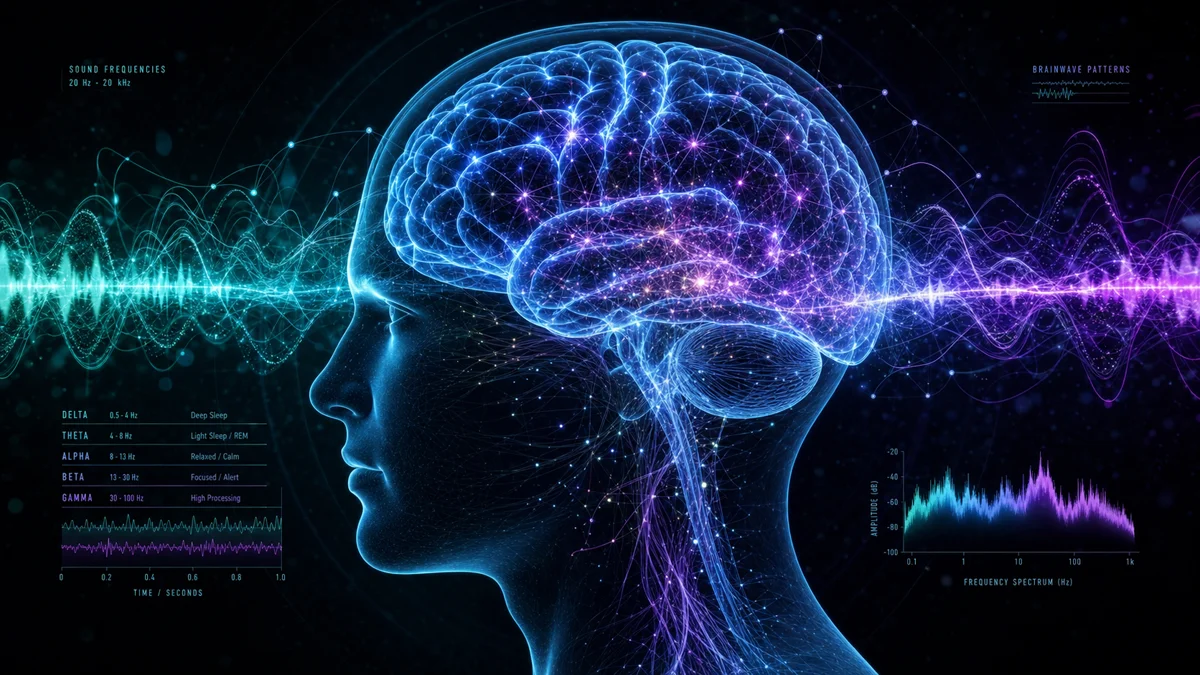
Delta (0.5–4 Hz) is for deep sleep. Theta (4–8 Hz) is for sleep onset, meditation, and light drowsy states. Alpha (8–12 Hz) is for calm, relaxed alertness, and creativity. Beta (12–30 Hz) is for active concentration. Gamma (30–100 Hz, typically 40 Hz) is for sharp focus and memory consolidation. Using an alpha protocol when you want to fall asleep, or a gamma protocol when you want to relax, will feel like the app "doesn't work" — because it's not designed for what you're asking of it.
Ambient noise and posture
Most protocols work best when you're sitting or lying quietly, in a low-noise environment, focused inward or on a single low-cognitive task. Trying to entrain to a focus protocol while doom-scrolling social media is a bit like trying to strength-train while asleep. The stimulus is there, but the neural conditions for adaptation aren't.
The realistic 4-week arc
If you're starting a frequency programme today, here's the arc the peer-reviewed research points to, calibrated conservatively:
Week 1: You'll notice some acute effects — feeling calmer during the session, falling asleep faster on nights you use it, feeling more locked-in immediately after a focus session. What you probably won't notice: a change in your baseline state when you're not using the app. That's normal. Don't quit here. This is where most people who write "it doesn't work" reviews quit.
Week 2: Sleep protocols usually start showing compound effects around now. If you're using a nightly sleep programme, you should be waking up less, sleeping longer, and feeling somewhat more restored. Focus and calm protocols are still mostly in acute-effect territory at this stage.
Week 3: Focus and calm start becoming measurable. Compared to your first week, you should notice that your ability to hold sustained attention feels slightly easier and lasts longer. Your baseline anxiety on a 1-10 scale should be a point or two lower than it was in week one. These changes are subtle enough that a lot of people don't realise they've happened until they think back explicitly.
Week 4 and beyond: Review your own experience and programme history. The Sharpe pilot reported memory improvement after eight sessions across four weeks, but only three people were in that arm, so treat it as a signal rather than a finding. Beyond that we are into honest speculation: no published trial tracks binaural-beat benefits week by week over a month, so we cannot tell you what week four reliably feels like, and findings from separate studies do not establish that a trait-level change should be obvious or that benefits plateau on a universal schedule. The meta-analytic evidence does favour longer exposures over shorter ones.
Why Tihna's programmes are 4 weeks long
Tihna's Sleep, Calm, Focus and Morning programmes use four-week sequences to provide a finite, repeatable routine. Four weeks is a product-design choice, not a promise that a trait-level change will appear.
Some programmes change frequency across the four weeks and some do not. Focus holds a steady 40 Hz throughout, because 40 Hz is the rate the attention research actually tested; what changes week to week is the length and consistency of the listening habit. Sleep moves from 6 Hz theta in weeks 1–2 to 3 Hz delta in weeks 3–4, and Calm moves from 9 Hz to 6 Hz. One caveat we should state plainly: no published study has compared a multi-week frequency progression against listening at a single frequency the whole time. The four-week shape is a design choice, not a research finding.
If you want the deeper breakdown of exactly what happens week-by-week and what to expect at each stage, see the How it works page.
How to know if it's working (without deceiving yourself)
The tricky thing about brain training is that its effects are usually gradual enough that you don't notice them the way you'd notice caffeine kicking in. This is why nearly every research protocol uses before-and-after measurements rather than asking participants "did you feel anything different?" — because subjective feelings alone are unreliable across timescales of weeks.
The single most useful thing you can do is write down a simple baseline on day one, then check it again at day 30. Pick two or three of these, whichever are most relevant to what you're training:
- Sleep: Track sleep onset time (how many minutes to fall asleep), number of times you remember waking during the night, and how rested you feel on a 1-10 scale on waking
- Focus: Note the longest sustained focus block you managed this week without checking your phone. Note it again in 30 days
- Calm: Rate your average anxiety on a 1-10 scale for the past week. Do it again after 30 days
- Morning: Time to feel mentally clear after waking (in minutes). Rate morning alertness at the 30-minute mark on a 1-10 scale
Two to three data points on day one, the same two to three data points on day 30. If the numbers moved in the right direction, the training worked. If they didn't, either you weren't consistent enough (missed too many days), the wrong protocol for your goal (using calm audio to try to focus), or you're in the minority of people who don't respond strongly to binaural stimulation — a well-documented individual variability the research literature acknowledges.
The bottom line
Research into auditory stimulation uses different signals, schedules, populations and outcome measures, and findings are mixed. Those studies did not test Tihna's exact programmes. There is no established timetable for a deeper sleep baseline, calmer default state or easier focus from using Tihna.
Judge an app by whether its listening format, safety information and routine fit your needs. Tihna offers a four-week structure and progress history without guaranteeing that the routine will produce an outcome.
Try Tihna's 4-Week Programmes Free
Four-week programmes for Morning, Focus, Calm and Sleep. Try the five-minute Quick Calm session and review current App Store options.
Download on App Store →References
- Jirakittayakorn, N. & Wongsawat, Y. (2017). Brain responses to a 6-Hz binaural beat: Effects on general theta rhythm and frontal midline theta activity. Frontiers in Neuroscience, 11:365 (n = 28). frontiersin.org/articles/10.3389/fnins.2017.00365
- Jirakittayakorn, N. & Wongsawat, Y. (2017). Brain responses to 40-Hz binaural beat and effects on emotion and memory. International Journal of Psychophysiology, 120, 96–107. sciencedirect.com/science/article/abs/pii/S0167876017300387
- Alzheimer's Drug Discovery Foundation. (2023). Gamma (40 Hz) Stimulation — Cognitive Vitality Report. alzdiscovery.org (PDF)
- Garcia-Argibay, M., Santed, M.A., & Reales, J.M. (2019). Efficacy of binaural auditory beats in cognition, anxiety, and pain perception: A meta-analysis. Psychological Research, 83(2), 357–372. pubmed.ncbi.nlm.nih.gov/30073406
- Dabiri, R., Monazzam Esmaielpour, M.R., Salmani Nodoushan, M., Khaneshenas, F. & Zakerian, S.A. (2022). The effect of auditory stimulation using delta binaural beat for a better sleep and post-sleep mood: A pilot study. Digital Health, 8. pmc.ncbi.nlm.nih.gov/articles/PMC9125055
- Yeom, J. et al. (2024). Effect of dynamic binaural beats on sleep quality. Sleep, 47(10), zsae097. academic.oup.com/sleep/article/47/10/zsae097
- Sharpe, R.L.S. et al. (2020). Gamma entrainment frequency affects mood, memory and cognition. Exploratory pilot, total N = 9 (n = 3 per arm). Brain Informatics, 7:17. pmc.ncbi.nlm.nih.gov/articles/PMC7683678
- Jirakittayakorn, C. & Wongsawat, Y. (2018). A novel insight of effects of a 3-Hz binaural beat on sleep stages during sleep. Frontiers in Human Neuroscience, 12:387. pmc.ncbi.nlm.nih.gov/articles/PMC6165862