Quick answer
How do you wind down for daytime sleep after night shift?
Protect the transition before you reach the pillow. Get home without driving drowsy, keep the post-shift routine short, reduce bright light, stop adding caffeine, prepare a dark, quiet and comfortably cool room, and use the same finite cue before bed. This can support a routine; it cannot cancel an unsafe roster, accumulated sleep debt or a sleep disorder.
A practical post-shift sequence
- Safety comes before the sleep routine—do not drive if you cannot do so safely.
- Move through food, showering and household tasks without opening a second “day”.
- Lower light and stimulation as bedtime approaches.
- Make the room dark, quiet and comfortably cool.
- Choose one bounded cue, then remove headphones before sleeping.
Night-shift workers often arrive home when the outside world is becoming brighter and busier. Public discussions among workers repeatedly describe waking after only a few hours of daytime sleep. Those discussions are useful evidence of the words people use and the situations they face, but they do not establish how common the problem is or which remedy works.
What the evidence says—and where it stops
An Australian cross-sectional study surveyed 588 shift workers. Almost half did not report seven to nine hours of sleep, and common practices included making the bedroom cool, dark and quiet. However, greater use of sleep-hygiene practices did not itself predict better sleep quality. The sample was recruited online, skewed towards women and healthcare workers, and the design cannot show cause and effect.
A separate Delphi study invited 155 sleep, shift-work and occupational-health experts; 68 joined the first round and 55 completed the third. They reached consensus on 18 tailored practices, including a bedtime routine, light management, caffeine timing and the sleep environment. This was expert consensus, not a trial showing that the whole checklist improves sleep. The authors explicitly called for effectiveness research.
Neither study tested Tihna, binaural beats, a 20-minute audio session or this routine as a package. A general paper about shift-worker sleep cannot be used as clinical proof for the app.
1. Make the trip home the first safety decision
Safe Work Australia describes fatigue as mental or physical exhaustion that reduces the ability to work safely and effectively. It specifically identifies driving, night work and safety-critical tasks as higher-risk situations. A wind-down plan is irrelevant if you are too drowsy to get home safely.
Use your workplace's fatigue process and a safe alternative—such as a lift, taxi, public transport where appropriate, or an approved rest arrangement—if you cannot drive safely. Tihna must not be used while driving, riding, walking near traffic or doing any task where headphones could block a warning.
2. Keep the post-shift routine deliberately small
Choose the few tasks that belong between work and sleep: a light meal if needed, shower, teeth, room setup and one wind-down cue. Move optional errands, housework and messages to after the main sleep where possible. The aim is not a perfect ritual; it is to avoid turning 7 am into another long waking period.
- Arrive: put work items in one place and switch off work alerts you do not need.
- Prepare: complete only the essential food, hygiene and household steps.
- Dim: lower light and screen brightness as bedtime approaches.
- Settle: use one repeatable, finite cue.
- Sleep: remove headphones, silence avoidable alerts and use the prepared room.
3. Treat light as part of the schedule
The Sleep Health Foundation advises limiting bright light before daytime sleep and offers sunglasses on the trip home as one possible strategy. Light timing is personal and interacts with the roster, days off and safety. Do not wear sunglasses when they make driving visibility unsafe, and seek tailored advice if you are deliberately shifting your body clock.
At home, close the curtains before you begin the routine, lower the lights and avoid a bright phone close to your face. This is a practical environmental step, not a promise that light control will overcome every shift pattern.
4. Prepare the room before you are exhausted
The Foundation's guidance recommends a dark, quiet and comfortably cool space, with individual adjustment. Prepare the room before the first night shift where possible: blackout curtains or an eye mask, reduced household noise, devices silenced and a clear plan with the people you live with.
If outside noise cannot be removed, use a safe solution that still allows you to hear alarms or emergency signals you need. Do not sleep in wired or over-ear headphones. A speaker, earplugs used according to their instructions or another room arrangement may suit some people better.
5. Stop chasing alertness into bedtime
Caffeine can help alertness during a shift, but its effects can last for hours and differ between people. Decide a personal cut-off by working backwards from the planned sleep time rather than from conventional evening advice. Alcohol may feel sedating but can reduce sleep quality, so it is not a dependable wind-down tool.
Medication and melatonin decisions belong with a qualified health professional, especially when other medicines, pregnancy, chronic conditions or safety-sensitive work are involved.
6. Use Tihna as an optional boundary—not the treatment
Tihna's current Sleep programme is presented as a 20-minute evening listening theme within a four-week structure, with a choice of eleven nature soundscapes or Pure Tone and progress tracking. For a night-shift worker, the label “evening” can mean the end of the worker's active period rather than the clock time.
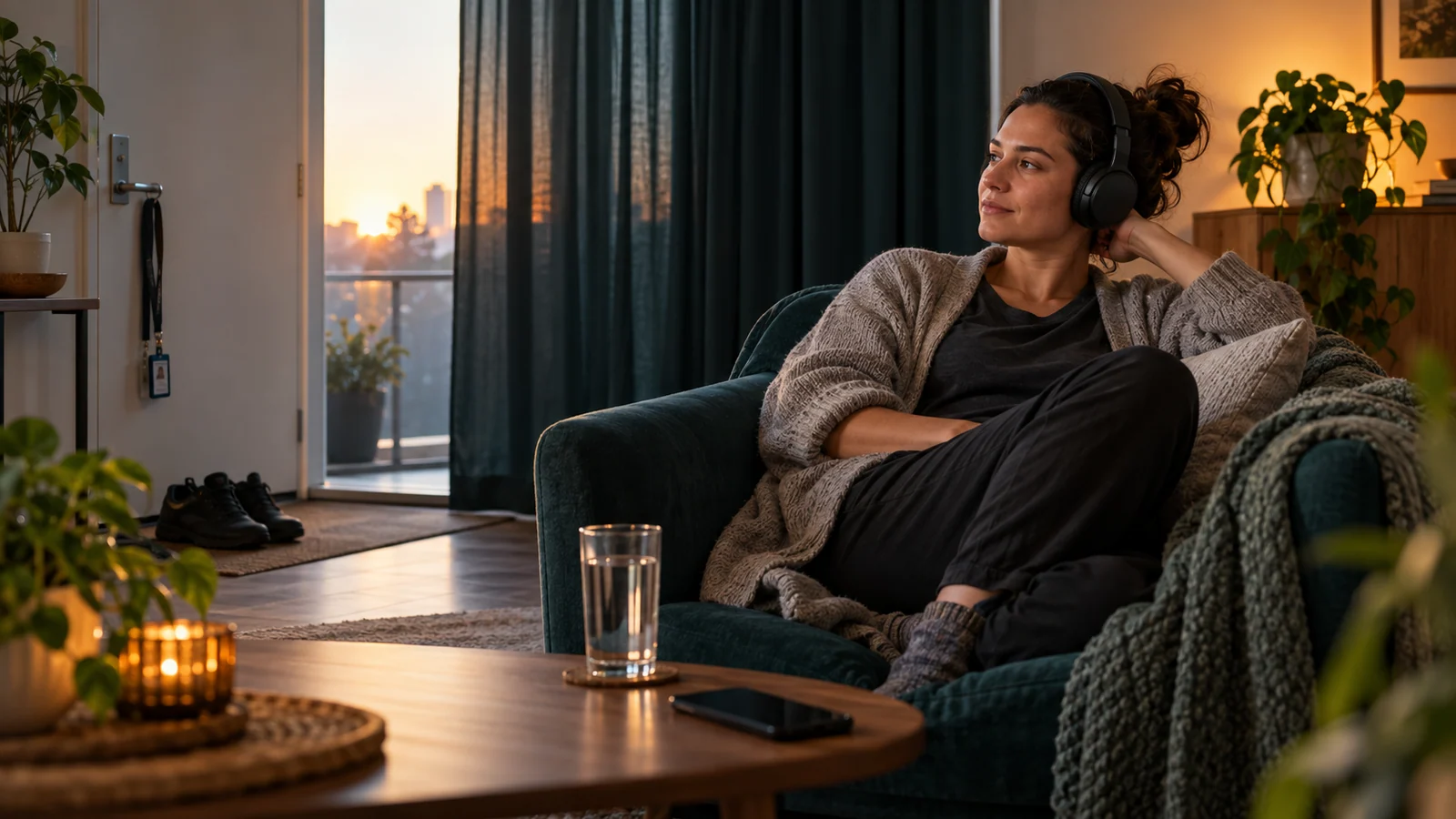
If the installed app shows a suitable Sleep session, a stationary 20-minute listen can be used as the finite cue between arriving home and getting into bed. Sit somewhere safe, keep the volume comfortable and remove the headphones when the session ends. The app does not monitor fatigue, set a roster, diagnose shift-work disorder or guarantee sleep.
If audio keeps you engaged, delays bed or is uncomfortable, skip it. A dim shower, quiet reading, stretching or another familiar low-stimulation cue can serve the same routine role without buying anything.
When the routine is not enough
Talk with a GP or qualified sleep professional if sleep problems occur repeatedly, you struggle to stay awake while driving or working, loud snoring or breathing pauses are reported, or fatigue is affecting safety, mood or daily functioning. Employers also retain responsibility for managing work-related fatigue risks; individual sleep advice does not transfer that duty to the worker.
Evidence, problem signals and limits
- Sleep Health Foundation — Healthy Sleep Practices for Shift Workers — Australian guidance updated 20 January 2026; covers sleep scheduling, routines, light, caffeine and bedroom conditions. General guidance is not individual medical advice.
- Shriane et al. (2023), Delphi consensus guidelines — 68 experts entered round one and 55 completed round three; consensus is not an effectiveness trial and no audio app was tested.
- Rampling et al. (2022), Australian shift-worker survey — cross-sectional convenience sample of 588; useful for observed practices and gaps, but self-report and sampling limit generalisation and causality.
- Safe Work Australia — Guide for Managing the Risk of Fatigue at Work — supports the safety boundary and shared workplace duties; it is national guidance, not the regulator for every jurisdiction.
- Public night-shift discussion about short daytime sleep — reviewed 1 October 2026 as audience language only; one discussion is not prevalence or treatment evidence.
Give the end of night shift one clear cue
Explore Tihna's current Sleep programme, sound choices and purchase options on the App Store.
Explore Tihna on the App Store →Disclosure: this article is published by Tihna. Tihna is a wellness app, not a medical device, fatigue-management system or treatment. The cited evidence did not test the complete Tihna app and does not guarantee an individual sleep, alertness, safety or health outcome.