Quick answer
Should you choose nature sounds or Pure Tone before bed?
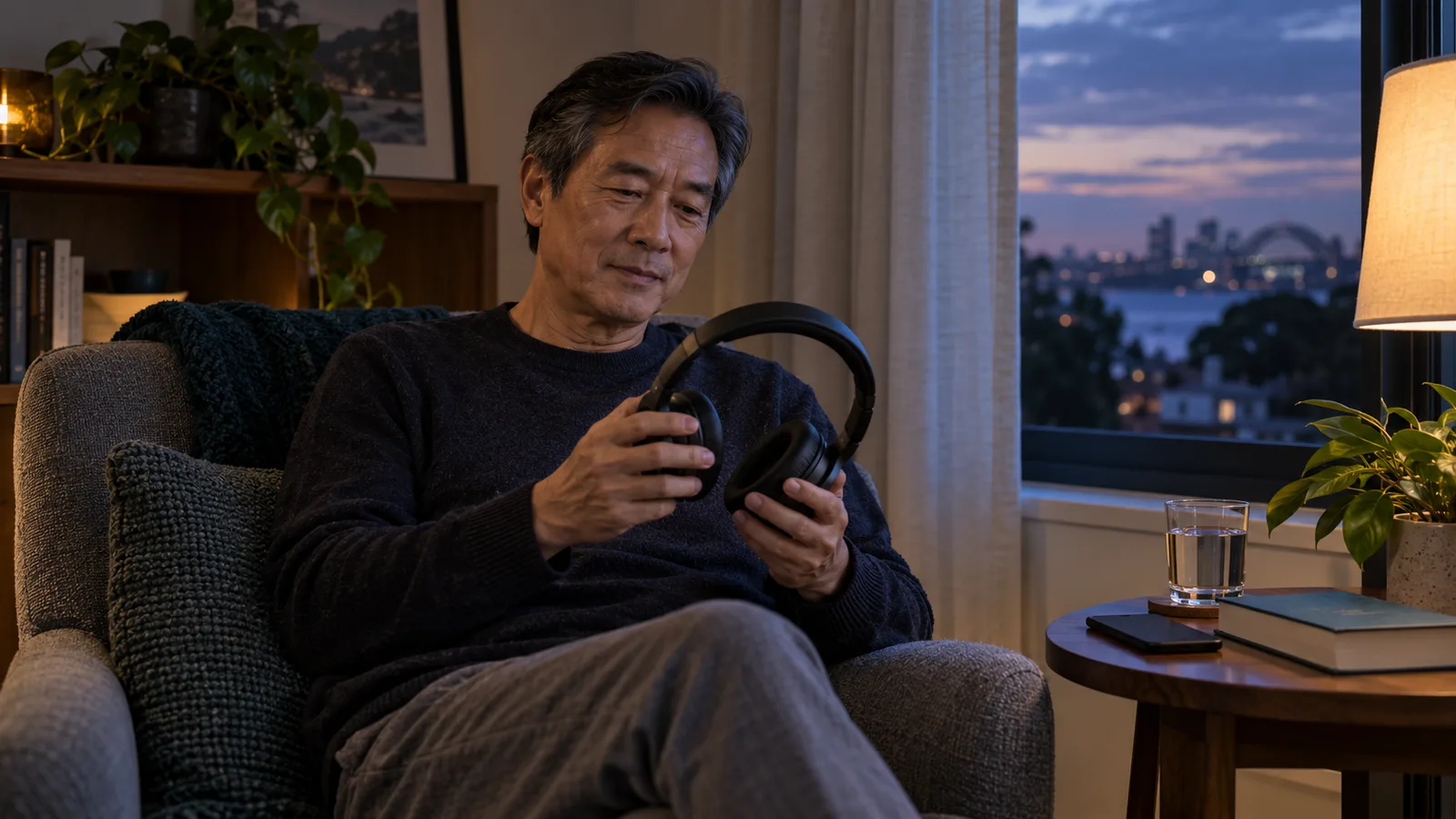
Choose the option that feels comfortable, predictable and easy to return to at a low listening level. A nature soundscape can soften the feel of a session; Pure Tone removes the background. Neither is proven universally better, and research on music or noise does not establish that Tihna—or one of its sound choices—will improve your sleep.
A simple first-listen check
- Set up well-fitted stereo headphones while seated.
- Keep the volume comfortable and use your device's safe-listening features.
- Try one option without switching repeatedly.
- Notice irritation, predictability and whether you want to return.
- Stop if the sound is uncomfortable or masks something you need to hear.
If you already use audio before bed, the difficult part may not be finding another enormous library. It may be choosing one sound, knowing how long the session lasts and deciding whether the routine feels worth repeating. Public discussions and app-store behaviour can show that people compare bedtime audio, but they do not establish one universal preference or a sleep benefit.
What is actually different?
Tihna's current bedtime page describes eleven nature soundscapes and a Pure Tone option. A nature soundscape adds an environmental background. Pure Tone plays the frequency tones without that nature background. The current Sleep programme uses 20-minute sessions and requires stereo headphones.
That is a product-choice difference, not evidence that one option changes sleep physiology more effectively. The current public product material does not claim that nature sounds are clinically superior, that Pure Tone is stronger, or that either will make you fall asleep within 20 minutes.
Choose a nature soundscape when the background is part of the comfort
A nature background may suit you if a familiar environmental texture makes the listening session feel less exposed or stark. Choose one that stays in the background rather than demanding attention.
- Listen for sudden details that make you alert rather than settled.
- Avoid constant switching in search of a perfect sound.
- Keep the level low enough that the background does not dominate the room.
- Notice whether the sound remains comfortable for the whole session.
Choose Pure Tone when you want less surrounding texture
Pure Tone may suit you if environmental recordings feel busy, sentimental or distracting. It removes the nature layer, but it is not a stronger treatment and it is not proof of a particular brain state.
- Begin at a comfortable low level.
- Give the sound a brief, fair listen rather than forcing yourself through irritation.
- Stop if you notice discomfort, ringing, pressure or a headache.
- Choose silence instead if neither option feels helpful.
What the sleep-audio evidence can—and cannot—tell you
A 2022 systematic review examined 34 studies of white noise, pink noise and mixed audio. Nineteen reported positive findings, but the authors concluded there was no strong evidence supporting auditory stimulation for sleep and called for better control of personal factors such as noise sensitivity. The review excluded music alone, binaural tones and synchronisation, so it does not test Tihna or decide between Tihna's sound choices.
A 2022 Cochrane review included 13 studies with 1,007 adults who reported sleep difficulties. It found moderate-certainty evidence of improved self-reported sleep quality after recorded-music listening, while evidence for insomnia severity and most other sleep outcomes was low or very low certainty. The studies used music for 25–60 minutes and did not test Tihna, Pure Tone, its programme structure or a 20-minute session.
The useful conclusion is modest: personal comfort and preference matter, the wider evidence is mixed and indirect, and a first listen should be treated as a fit check—not a prediction of a health outcome.
A safe pre-bed setup checklist
- Settle first: be seated or lying safely before playback. Do not use the session while driving, walking near traffic, operating machinery or supervising a hazard.
- Check the route: connect suitable stereo headphones as directed by the app.
- Lower the level: start quieter than you think you need, then adjust only for comfort.
- Choose once: pick a nature soundscape or Pure Tone for this session rather than browsing throughout.
- Keep an exit: stop if the sound is irritating or you need environmental awareness.
The World Health Organization says volume, duration and frequency of loud-sound exposure all affect hearing risk. It recommends keeping device volume below 60% of maximum, using well-fitted headphones and taking listening breaks. Individual devices and environments vary, so use exposure monitoring and volume limiting where available.
Judge the routine by fit, not by a perfect night
After a session, ask three non-clinical questions: Was the sound comfortable? Did the clear finish reduce browsing? Would I willingly choose the same setup again? A single difficult or easy night cannot show that the audio caused the outcome.
If free audio already gives you a comfortable, bounded routine, you may not need another app. Tihna's relevant difference is its current structured 20-minute Sleep session, sound choice and visible programme progress—not exclusive access to nature audio and not a guaranteed sleep result.
Quick Calm is not a free Sleep session
The current Australian App Store listing says a five-minute Quick Calm session is available without a subscription. That lets you check the listening setup and general experience; it is not the paid 20-minute Sleep programme and does not predict whether Sleep will suit you. Review the current purchase sheet for subscription, lifetime, trial, renewal and cancellation terms before choosing a paid option.
Evidence, product proof and limits
- Capezuti et al. (2022), systematic review of auditory stimulation and sleep — mixed findings across white, pink and mixed audio; no strong overall evidence and no Tihna test.
- Jespersen et al. (2022), updated Cochrane review of music for adult insomnia — 13 studies and 1,007 participants; moderate-certainty evidence for self-reported sleep quality, with low- or very-low-certainty evidence for most other outcomes. It did not test Tihna.
- WHO safe-listening guidance — reviewed 13 October 2026 for volume, fit, breaks and monitoring advice.
- Tihna bedtime listening page — reviewed 13 October 2026 for current 20-minute Sleep length, stereo-headphone setup, eleven soundscapes and Pure Tone choice. This is direct product evidence, not independent efficacy evidence.
- Australian App Store listing — reviewed 13 October 2026 for the five-minute Quick Calm offer and current public programme description. Purchase-sheet terms can vary and must be checked in the app.
See the bedtime setup and current app options
Review the 20-minute Sleep setup, sound choices and honest free-versus-paid distinction before deciding whether Tihna fits your routine.
See the bedtime setup →Disclosure: this article is published by Tihna. Tihna is a wellness app, not a medical device or treatment. The cited research did not test the complete Tihna app and does not guarantee an individual sleep, relaxation, safety or health outcome.